

Hotels can no longer rely on occupancy alone to drive profitability. Rising guest expectations, shifting travel demand and increasing OTA competition mean hotels need smarter strategies to maximize every booking opportunity. That’s where hotel revenue management and yield management play a part. These terms serve different purposes. Understanding how both strategies work together can help hotels increase revenue, improve profitability and create better guest experiences.
Hotel Revenue Management vs Yield Management
Hotel revenue management is the strategic process of maximizing hotel profitability by selling the right room, to the right guest, at the right price, through the right channel, at the right time.
Modern hotel revenue management goes beyond filling rooms. Today, it focuses on:
- Room revenue
- Ancillary revenue
- Guest lifetime value
- Distribution strategy
- Profit optimization
Revenue management combines data analysis, forecasting, pricing strategy, and technology to help hotels make smarter commercial decisions.
Key Hotel Revenue Management Metrics
Common KPIs include:
- ADR (Average Daily Rate)
- RevPAR (Revenue Per Available Room)
- GOPPAR (Gross Operating Profit Per Available Room)
- Occupancy Rate
- TRevPAR (Total Revenue Per Available Room)
As hotels evolve, many revenue teams are shifting focus from RevPAR alone toward total profitability and guest spend.
What Is Yield Management in Hotels?
Whereas hotel revenue management is the strategy of maximizing hotel profit by selling the right room to the right guest at the right price and time. Hotel yield management is a pricing strategy focused specifically on maximizing room revenue from a fixed inventory.
Because hotel rooms are perishable inventory, once a night passes, unsold rooms can never be recovered. Yield management helps hotels optimize pricing and occupancy to reduce revenue loss.
The core principle is simple:
Sell the right room to the right guest at the highest possible price.
Yield management typically focuses on:
- Dynamic pricing
- Occupancy optimization
- Demand forecasting
- Inventory control
- Rate adjustments
Hotel Yield Management Formula
A common yield management formula is:
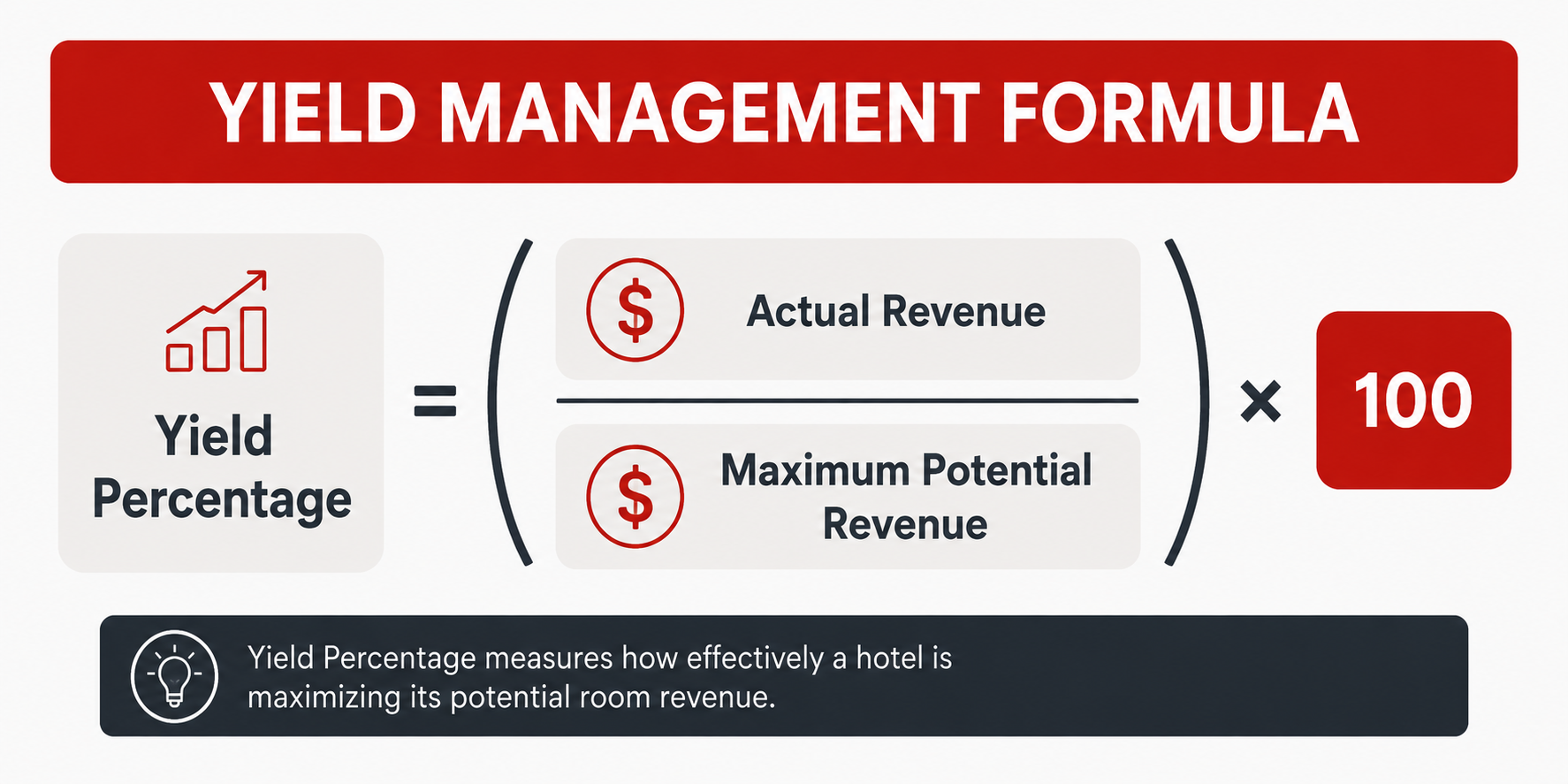
This formula measures how effectively a hotel is maximizing its potential room revenue.
Hotel Revenue Management vs Yield Management
Although closely related, there are important differences between revenue management and yield management.
|
Yield Management |
Revenue Management |
|
Focuses on room pricing |
Focuses on total hotel profitability |
|
Tactical and short-term |
Strategic and long-term |
|
Centers around occupancy and ADR |
Includes ancillary revenue and guest value |
|
Mainly room inventory optimization |
Includes multiple revenue streams |
|
Pricing-focused |
Guest journey and profit-focused |
In short:
- Yield management is one part of a broader hotel revenue management strategy.
- Revenue management looks at the full commercial picture.
Why Hotel Revenue Management Matters
Hotels operate in an industry where demand constantly changes. Seasonality, local events, flight disruptions, holidays, and competitor pricing can all impact booking behavior overnight.
Effective revenue management helps hotels:
- Increase profitability
- Improve occupancy
- Reduce unsold inventory
- Drive more direct bookings
- Maximize ancillary revenue
- Improve forecasting accuracy
- Enhance guest personalization
Hotels that embrace modern revenue strategies are better equipped to compete in an increasingly digital and data-driven market.
7 Hotel Revenue Management Strategies That Drive Profitability
1. Dynamic Pricing
Dynamic pricing allows hotels to adjust room rates in real time based on market demand, occupancy levels, and competitor pricing.
This helps hotels remain competitive while maximizing revenue during high-demand periods.
Dynamic pricing factors include:
- Local events
- Seasonality
- Booking pace
- Market demand
- Competitor rates
- Remaining inventory
2. Forecasting Demand
Demand forecasting helps hotels anticipate future booking trends and make proactive pricing decisions.
Strong forecasting strategies analyze:
- Historical occupancy data
- Booking windows
- Market trends
- Event calendars
- Guest segments
- Seasonal patterns
Forecasting enables hotels to optimize pricing before demand peaks or softens.
3. Market Segmentation
Not every guest books the same way.
Revenue management strategies become more effective when hotels segment audiences such as:
- Business travelers
- Families
- Groups
- Leisure travelers
- Solo travelers
- Luxury guests
- Value-conscious guests
Segment-specific pricing and promotions improve conversion rates and profitability.
4. Increase Direct Bookings
Direct bookings are one of the most profitable channels because they reduce OTA commission costs and strengthen guest relationships.
Hotels can increase direct bookings by:
- Improving website UX
- Optimizing SEO
- Offering exclusive perks
- Using AI chat and booking tools
- Running targeted email campaigns
- Leveraging loyalty programs

5. Optimize Ancillary Revenue
Modern hotel revenue management is no longer limited to room sales.
Hotels are increasingly maximizing:
- Room upgrades
- Late checkout
- Spa treatments
- Dining reservations
- Parking
- Experiences
- Event packages
Personalized upselling strategies can significantly increase total guest spend while improving the guest experience.
6. Monitor Competitor Pricing
Competitive analysis remains a core component of yield management.
Hotels should regularly monitor:
- Daily room rates
- Promotions
- Occupancy trends
- Availability restrictions
- Market positioning
This helps revenue teams stay agile and avoid pricing themselves out of the market.
7. Use AI and Hotel Revenue Technology
AI-powered revenue management systems help hotels automate pricing, forecasting, and upselling strategies.
Modern hospitality technology can:
- Analyze demand patterns instantly
- Recommend optimal pricing
- Trigger automated upsell offers
- Predict guest behavior
- Improve forecasting accuracy
AI is quickly becoming a core part of hotel revenue optimization strategies.
The Future of Hotel Revenue Management
The hospitality industry is changing from traditional revenue management toward total profit optimization.
Hotels are now focusing on:
- Guest personalization
- Total revenue management
- AI-driven pricing
- Data-driven decision making
- Guest lifetime value
As competition increases, hotels that combine smart pricing with exceptional guest experiences will outperform the market.
Final Thoughts
Both hotel revenue management and yield management are essential for modern hospitality businesses.
Yield management helps optimize room pricing and occupancy, while revenue management takes a broader view of total profitability and guest value.
Together, these strategies help hotels:
- Maximize every booking
- Increase direct revenue
- Improve operational efficiency
- Deliver better guest experiences
- Drive long-term profitability
Successful hotels are no longer just selling rooms, they’re optimizing every guest interaction for revenue growth.
By combining upselling technology, frontline training, performance analytics and guest engagement tools, FPG enables hotels to optimize room revenue, increase ancillary spend, and improve overall guest value. Its solutions help hotel teams deliver personalized upgrade offers at the right time, driving higher paid occupancy into premium category rooms, stronger profit margins and increased revenue across the guest journey.
Read more on our blog, Front Office Excellence: Turning Every Guest Interaction Into Opportunity, and discover how frontline teams can drive revenue, elevate guest experiences, and unlock new opportunities at every touchpoint.